Category: Coins

Digital assets, cryptocurrencies, blockchain, and currency news.

  • XRP $2 Roadmap: Weekly Close Could Trigger 35% Rally

    XRP $2 Roadmap: Weekly Close Could Trigger 35% Rally

    Key Highlights

    • XRP is forming a technically precise inverse head-and-shoulders pattern on the daily chart with a neckline at $1.55, projecting a 35% upside target near $2.00 upon confirmed breakout.
    • On-chain data shows 1.5–1.6 billion XRP moved to Binance over 30 days—a six-month high—yet price remains stable in the right shoulder range, signaling strong absorption by buyers.
    • A potential golden cross is developing as the 50-day EMA approaches the 200-day EMA, while Ripple advances XRP Ledger integration with Stripe and Tempo for AI-driven micropayments.

    Inverse Head-and-Shoulders Pattern Nears Completion on Daily Chart

    XRP is on the verge of confirming a major bullish reversal structure that has been developing throughout the summer. According to analysts, including well-known chart tracker Ali Martinez, the token has carved out a mathematically precise inverse head-and-shoulders formation on the daily timeframe. The pattern’s anatomy is clearly defined: the left shoulder formed during June’s consolidation phase, the head marked the absolute bottom at the August lows around $1.00, and the right shoulder is currently taking shape in a tight plateau between $1.32 and $1.36.

    The $1.55 Neckline Is the Critical Trigger

    The decisive level is the pattern’s neckline at $1.55. A daily candle close above this resistance would technically complete the formation and activate a measured move projection of approximately 35%, targeting the psychological $2.00 threshold. Martinez’s chart annotation, shared via X.com, displays the emerging structure with a price objective of $2.10. Adding confluence to the setup, the 50-day exponential moving average (EMA) has moved within 2% of the 200-day EMA, teasing a medium-term golden cross that would further validate the bullish bias.

    On-Chain Data Reveals Massive Whale Deposits Absorbed Without Panic

    While technical geometry paints an optimistic picture, on-chain metrics from CryptoQuant provide the fundamental underpinning. Over the past 30 days, large investors have transferred a six-month record of 1.5–1.6 billion XRP to Binance. In exchange operations, deposits of this magnitude typically serve as margin collateral, derivatives backing, or fuel for over-the-counter transactions rather than immediate spot selling. The critical observation is that this enormous liquidity influx has failed to trigger price collapse or panic; instead, XRP has held firmly within the right-shoulder boundaries. This resilience suggests buyers are aggressively absorbing supply, potentially creating a structural shortage once whale inflows subside.

    Regulatory Clarity and Utility Expansion Bolster Confidence

    Buyer conviction is further reinforced by a stabilizing regulatory and developmental backdrop. The U.S. Senate’s rejection of the CLARITY Act on September 15 delivered a short-term negative headline, yet the Commodity Futures Trading Commission (CFTC) continues to classify XRP as a digital commodity, largely insulating it from Securities and Exchange Commission (SEC) enforcement ambiguity. Simultaneously, Ripple is advancing the token’s core utility: beta testing of XRP Ledger integration into Stripe and Tempo infrastructure commenced on September 17, carving a dedicated niche for XRP in instant micropayments between autonomous AI agents—a rapidly emerging use case.

    Why This Matters

    The convergence of a textbook technical breakout, unprecedented on-chain absorption capacity, and expanding real-world utility positions XRP at a pivotal inflection point. For market participants, the $1.32–$1.33 right-shoulder support represents the line in the sand; a defense here keeps the $2.00 roadmap intact. A confirmed daily close above the $1.55 neckline would shift the burden of proof to bears and likely accelerate momentum as algorithmic and trend-following strategies engage. Beyond the immediate trade, the Stripe and Tempo integration signals a strategic pivot toward machine-to-machine economies, potentially unlocking a structural demand vector independent of speculative cycles. Traders and investors should monitor the neckline breakout, golden cross confirmation, and whale deposit trends as the primary validation signals for the next leg higher.

    Frequently Asked Questions

    What price level confirms the inverse head-and-shoulders breakout for XRP?

    A daily candle close above the $1.55 neckline resistance confirms the pattern completion and activates the measured move target toward $2.00.

    Why did 1.5–1.6 billion XRP move to Binance recently, and is it bearish?

    Large transfers to exchanges often serve as collateral for derivatives or OTC deals rather than spot selling. The fact that price held firm during this record inflow suggests strong buyer absorption, which is generally interpreted as bullish.

    How does the Stripe and Tempo integration affect XRP’s long-term outlook?

    The beta integration enables XRP Ledger to facilitate instant micropayments between autonomous AI programs, creating a fundamental utility driver in the emerging agent-to-agent economy that could sustain demand beyond speculative trading.

  • Solana Surges to $112 as BSOL Trading Volume Hits $85 Million

    Solana Surges to $112 as BSOL Trading Volume Hits $85 Million

    Key Highlights

    • Solana (SOL) surged 11% to $112, its highest level since January, driven by a massive short squeeze liquidating $36.72 million in bearish derivative positions.
    • The Bitwise Solana Staking ETF (BSOL) jumped 12.04% to $15.54 with $85 million in trading volume, signaling strong institutional appetite for structured staking products.
    • Ecosystem fundamentals strengthened with Project Harmonia linking Solana to Allfunds (€1.9T AUM), tokenized real-world assets exceeding $4 billion, and MoneyGram expanding to 170+ territories.

    SOL Price Breaks $112 as Short Squeeze Triggers Derivative-Led Rally

    Solana’s native token SOL rallied 11% within 24 hours to reach $112 per unit on Friday, marking its highest valuation since January. The sharp ascent was not a spot-market anomaly but a derivative-fueled move underscored by extreme positioning imbalances. According to market data, total liquidations across SOL-linked contracts hit $38.21 million in a single day, with an overwhelming $36.72 million—approximately 96%—stemming from short positions. Only $1.48 million in long liquidations were recorded, confirming a classic short-squeeze dynamic that forced bearish traders to cover at progressively higher prices.

    Bitwise Solana Staking ETF Sees Record Intraday Volume

    Amplifying the bullish momentum, the Bitwise Solana Staking ETF (BSOL) advanced 12.04% to $15.54 per share, printing an intraday trading volume of roughly $85 million. Analysts cited by the source suggest that rising institutional interest in structured staking vehicles is acting as a direct catalyst for underlying asset liquidity. The ETF’s performance mirrors a broader shift: futures volume on SOL reached $12.14 billion over 24 hours, dwarfing the $1.49 billion recorded in spot order books. CoinGlass metrics place global open interest in SOL futures near $7 billion, indicating that leveraged derivatives remain the primary price-discovery venue for the asset.

    Institutional Infrastructure Expands via Project Harmonia and RWA Growth

    Friday’s price action coincided with a cluster of fundamental milestones. The Solana Foundation this week unveiled Project Harmonia, a strategic integration connecting the network’s infrastructure with Allfunds, the world’s largest fund distribution network. Allfunds manages nearly €1.9 trillion in assets and interconnects more than 3,300 investment managers and financial institutions, potentially opening a massive traditional-finance distribution channel for Solana-based products.

    In parallel, on-chain data reveals that the total value of tokenized real-world assets (RWA) on Solana has surpassed $4 billion, with the number of addresses holding such instruments exceeding 350,000 active accounts. The xStocks platform alone reported more than $500 million in assets under management. Payment rails are also widening: MoneyGram Ramps recently enabled services on Solana, allowing fiat deposits from over 25 countries and cash withdrawals across more than 170 territories.

    Protocol Upgrade Targets Sub-200-Millisecond Block Times

    On the technical front, core developers are executing a staggered reduction in slot duration—from the current 400 milliseconds toward a final target of 200 milliseconds. Specifications disclosed in August outline the phased approach, and the community’s attention is now fixed on the completion of the testing phase scheduled for late September. That milestone will evaluate the protocol’s performance under high transaction demand, a critical stress test as the network onboards institutional-grade throughput requirements.

    Why This Matters

    The convergence of a violent short squeeze, record ETF volume, and accelerating institutional infrastructure marks a potential regime change for Solana. For months, the narrative centered on retail-driven memecoin activity and periodic network outages. Friday’s data suggests a structural shift: derivatives markets are deepening, traditional asset managers are plugging in via Allfunds, and real-world asset tokenization is crossing the $4 billion threshold. If the September block-time upgrade delivers as planned, Solana will offer a combination of speed, institutional connectivity, and regulated product access—BSOL being the first U.S.-listed staking ETF—that few competing layer-1 blockchains can match. The next catalyst watchpoints are the September testnet results, BSOL flow data, and whether RWA issuance sustains its exponential trajectory.

    Frequently Asked Questions

    What caused Solana’s 11% price jump to $112?
    A massive short squeeze in the derivatives market forced the liquidation of $36.72 million in short positions—96% of total liquidations—driving spot prices higher as bearish traders rushed to cover.
    How significant is the Bitwise Solana Staking ETF (BSOL) volume?
    BSOL traded approximately $85 million in a single session alongside a 12.04% price gain, indicating strong institutional demand for regulated, yield-bearing Solana exposure and suggesting ETF flows are now a material liquidity driver for SOL.
    What is Project Harmonia and why does it matter?
    Project Harmonia is a Solana Foundation initiative that integrates the blockchain with Allfunds, the world’s largest fund distribution network (€1.9T AUM, 3,300+ institutions). It creates a direct pipeline for traditional asset managers to distribute Solana-based financial products.
  • MicroStrategy (MSTR) Stock Rallies Over 16% as Bitcoin Surges

    MicroStrategy (MSTR) Stock Rallies Over 16% as Bitcoin Surges

    Key Highlights

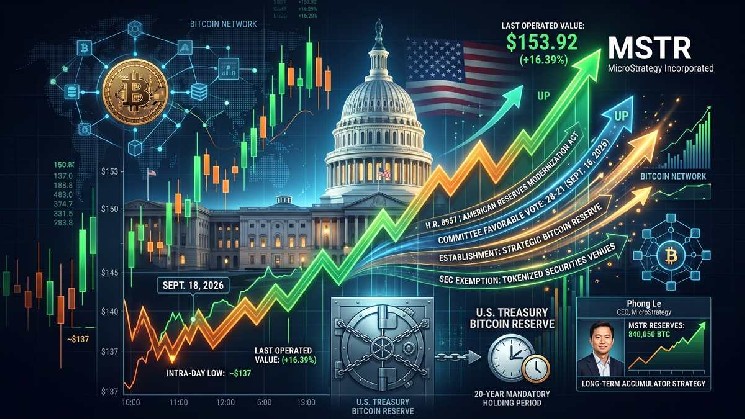
    • Strategy (MSTR) surged 16.39% to close at $153.92 on September 18, 2026, lifting its market capitalization above $59.5 billion amid renewed institutional demand.
    • The House Financial Services Committee advanced the American Reserve Modernization Act (H.R. 8957) by a 28–21 vote on September 16, proposing a U.S. Strategic Bitcoin Reserve with a mandatory 20-year federal custody requirement.
    • Strategy CEO Phong Le confirmed the firm holds 840,050 BTC and reiterated its long-term accumulation strategy, while leaving the door open for minor sales if market conditions or traditional finance integration warrant it.

    MSTR Rallies on Congressional and Regulatory Catalysts

    Strategy’s flagship stock staged a sharp recovery during the September 18, 2026 session, climbing 16.39% to finish at $153.92 after an intraday low near $137. Data from Yahoo Finance showed the company’s market capitalization breaching $59.5 billion during the session, reflecting a resurgence of institutional interest tied directly to legislative and regulatory developments in Washington.

    House Committee Advances Strategic Bitcoin Reserve Legislation

    The bullish momentum coincided with a pivotal vote on September 16, when the U.S. House Financial Services Committee endorsed the American Reserve Modernization Act (H.R. 8957) by a 28-to-21 margin. The legislative text directs the U.S. Department of the Treasury to formally establish a Strategic Bitcoin Reserve. The terms of the bill stipulate that funds qualifying to join the reserve must remain held under federal custody for a mandatory period of no less than 20 years. Lawmakers also introduced technical amendments regarding regular proof-of-reserve reporting and instruments acquired through network hard forks. The full House vote on H.R. 8957 remains unscheduled, and its timing will shape the broader debate over federal custody of digital reserves.

    SEC Grants Temporary Exemption for Tokenized Securities Platforms

    Compounding the legislative tailwind, the U.S. Securities and Exchange Commission granted a temporary regulatory exemption to authorized tokenized securities trading platforms. This measure permits trading certain U.S. assets through regulated automated market makers and permissioned liquidity pools. Market analysts consider that this conditional opening by the SEC could stimulate trading volume for digital-asset-linked equities over the coming months.

    Strategy’s Bitcoin Holdings and Corporate Strategy

    Strategy’s operational exposure remains closely correlated with the cryptocurrency spot market. In a public statement issued Friday, September 18, company CEO Phong Le confirmed that the firm holds 840,050 BTC in its reserve. Le confirmed that the organization’s primary objective remains consolidating its position as a long-term accumulator. However, the executive clarified that management considers the potential sale of small amounts of Bitcoin should market conditions or integration with traditional finance warrant it.

    Technical Analysis Signals Continued Upside Potential

    From a technical perspective on TradingView’s weekly chart, the price of MSTR broke above the descending trendline carried over from its July 2025 highs near $452. The TradingView technical report highlights that the stock managed to position itself above its 20-week exponential moving average (EMA), located at $128.64. The weekly Relative Strength Index (RSI) hovered around 55 points. This technical reading suggests the asset still trades outside the standard overbought threshold of 70 points, potentially leaving room for extended consolidation if trading volume remains steady.

    Why This Matters

    The convergence of legislative progress on a federal Bitcoin reserve and the SEC’s willingness to pilot tokenized securities infrastructure marks a significant inflection point for digital asset integration into the U.S. financial system. H.R. 8957, if enacted, would institutionalize Bitcoin as a strategic reserve asset under long-term federal custody, potentially validating the thesis that underpins Strategy’s corporate strategy. Simultaneously, the SEC’s exemption for permissioned liquidity pools signals a regulatory appetite for controlled innovation in tokenized markets. For Strategy, the 840,050 BTC reserve—worth approximately $50 billion at current prices—serves as both a corporate treasury asset and a de facto proxy for institutional Bitcoin exposure. The market’s reaction suggests investors are pricing in a higher probability of favorable regulatory outcomes, though the full House vote on H.R. 8957 and the SEC’s eventual permanent rulemaking remain critical uncertainties.

    Frequently Asked Questions

    What is the American Reserve Modernization Act (H.R. 8957)?

    H.R. 8957 is a bill advanced by the House Financial Services Committee on September 16, 2026, that directs the U.S. Department of the Treasury to establish a Strategic Bitcoin Reserve. Qualifying assets must remain in federal custody for a minimum of 20 years, and the legislation includes provisions for proof-of-reserve reporting and treatment of assets from network hard forks.

    How much Bitcoin does Strategy currently hold?

    As confirmed by CEO Phong Le on September 18, 2026, Strategy holds 840,050 BTC on its corporate balance sheet, making it one of the largest corporate holders of Bitcoin globally.

    What does the SEC’s temporary exemption for tokenized securities platforms entail?

    The exemption authorizes regulated automated market makers and permissioned liquidity pools to trade certain U.S. assets in tokenized form. It is a conditional, temporary measure that analysts believe could increase trading volume for digital-asset-linked equities like MSTR in the near term.

  • XRP ETFs Face Setback, But Institutional Investors Hold Tokens

    XRP ETFs Face Setback, But Institutional Investors Hold Tokens

    Key Highlights

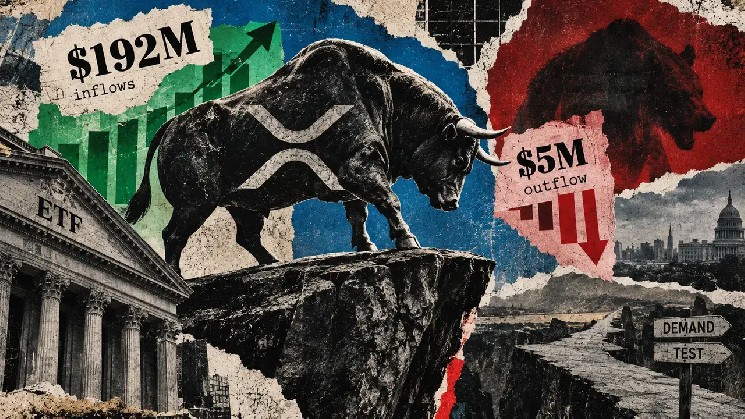
    • US spot XRP exchange-traded products recorded a $5.15 million outflow on September 17, breaking a month-long streak of inflows totaling $192 million.
    • The single-day reversal marks the first significant test of whether sustained investor demand for XRP-linked investment vehicles is beginning to cool.
    • Despite the interruption, cumulative flow data indicates the broader monthly trend remains strongly positive for XRP ETPs.

    XRP ETP Flow Reversal Snaps Month of Steady Inflows

    US spot XRP exchange-traded products (ETPs) experienced a notable shift in momentum on September 17, registering approximately $5.15 million in net outflows. This single-day withdrawal halted a consistent accumulation phase that had seen the category attract roughly $192 million in net new capital over the preceding month. The reversal represents the first material stress test of the bullish flow dynamics that have characterized XRP investment products since their broader market acceptance.

    Market Context: Testing the Durability of XRP Demand

    The outflow event arrives after a period of robust institutional and retail appetite for regulated XRP exposure. For weeks, the asset class benefited from favorable regulatory tailwinds and growing recognition of XRP’s utility in cross-border payments, driving near-uninterrupted capital inflows. The September 17 figure, while modest relative to the month’s total intake, is analytically significant because it provides the first clean data point to assess whether the buying pressure has reached a near-term saturation point or if the underlying demand curve remains intact.

    Broader Flow Pattern Remains Constructive

    Analysts observing the fund flow data emphasize that a single session of redemptions does not invalidate the prevailing trend. The $192 million monthly inflow figure dwarfs the recent outflow, suggesting the product category is still in a net accumulation phase. Market participants will closely monitor subsequent trading sessions to determine if September 17 was an isolated profit-taking event or the leading edge of a sentiment shift. The resilience of the broader monthly pattern offers a statistical buffer against over-interpreting one day’s activity.

    Why This Matters

    Flow data for spot crypto ETPs serves as a primary proxy for institutional and sophisticated retail sentiment. For XRP specifically, sustained inflows have validated the market structure built around the asset following years of regulatory uncertainty. A confirmed trend reversal could signal reduced appetite for crypto-linked traditional finance products broadly, while a quick resumption of inflows would reinforce the narrative that XRP has graduated to a core portfolio holding for digital asset allocators. The next week of flow reports will be critical for calibrating expectations for Q4 product launches and asset under management (AUM) growth trajectories.

    Frequently Asked Questions

    How significant is a $5.15 million outflow relative to the monthly total?
    The outflow represents approximately 2.7% of the $192 million in net inflows recorded during the month. While technically a reversal, the magnitude is small enough to be consistent with routine portfolio rebalancing or short-term profit taking rather than a structural shift in demand.
    What does “clean test” mean in the context of ETP flows?
    A “clean test” refers to the first unambiguous counter-trend move after an extended period of one-directional flows. It allows analysts to observe investor behavior—specifically whether new buyers step in to absorb the selling—without the noise of overlapping mixed signals.
    Could this outflow impact the approval or launch of new XRP investment products?
    Regulators and issuers typically evaluate multi-week and multi-month flow trends rather than single-day prints. Unless the outflows accelerate into a sustained trend, this data point alone is unlikely to influence product pipeline decisions.
  • Bitcoin Bullish Phase Forms, but Overbought Conditions Signal Caution

    Bitcoin Bullish Phase Forms, but Overbought Conditions Signal Caution

    Key Highlights

    • CryptoQuant analysis indicates Bitcoin has exited extreme bubble-or-crash conditions and is gradually approaching a full-fledged bullish rally after a period of correction and consolidation.
    • JPMorgan reports institutional investors are more defensively positioned toward Bitcoin than gold, with heavy put-option activity around ETFs such as BlackRock’s IBIT creating potential for $1 trillion in hedge unwinding and short-covering pressure if prices rise.
    • Technical indicators flash mixed signals: Bitcoin trades near $78,241 with RSI in overbought territory and widening Bollinger Bands signaling elevated volatility, while macro headwinds including a Fed rate hike and stronger dollar cloud the Q4 outlook.

    Bitcoin Exits “Weakness Zone” as Cycle Structure Shifts

    The digital asset market is undergoing a notable sentiment shift in the second half of 2027. After failing to breach a long-standing resistance level during the first half of the year, Bitcoin ($BTC) appears to be transitioning toward a bullish phase, according to a recent analysis by on-chain analytics firm CryptoQuant. The firm’s bubble-versus-crash market structure indicator shows that the extreme conditions historically associated with either a speculative bubble or a severe crash have dissipated.

    Bitcoin has already navigated a period of correction and consolidation, yet it has not experienced the kind of extreme speculative mania that typically marks major cycle tops. This suggests the asset may still have room to enter a stronger upward trend. As CryptoQuant stated directly in its report:

    The full-fledged bullish rally has not yet begun. Currently, it is in the process of gradually approaching that stage.

    Institutional Positioning: Bitcoin vs. Gold Dynamics

    Adding weight to the constructive outlook, JPMorgan has highlighted a striking divergence in institutional positioning. The bank notes that investors are currently more defensively positioned toward Bitcoin than toward gold. This defensive stance manifests in elevated short interest and significant put-option activity around Bitcoin exchange-traded funds, most notably BlackRock’s IBIT.

    While gold ETFs have recovered more of their 2026 outflows, Bitcoin carries relatively heavier bearish hedging. However, JPMorgan emphasizes that this hedging does not necessarily reflect outright bearish conviction. Instead, it creates a coiled spring effect: if Bitcoin rallies, these protective hedges could be unwound rapidly, generating additional buying pressure. The potential market impact of such hedge unwinding and short covering is estimated to be worth approximately $1 trillion.

    Technical Crosscurrents: Overbought RSI Meets Expanding Volatility

    At press time, Bitcoin was changing hands at $78,240.79, representing a 2.5% gain over the preceding 24 hours. Despite the upward momentum, technical indicators are flashing caution. The Relative Strength Index (RSI) has entered overbought territory, a classic warning sign that bears may attempt to pull back the recent advance. Simultaneously, widening Bollinger Bands indicate that volatility is expanding significantly, suggesting the current price action may be unstable.

    These conflicting signals—bullish structure on-chain versus overbought momentum and rising volatility on the chart—create a tug-of-war that traders will need to navigate carefully in the near term.

    Macro Headwinds Complicate Q4 Outlook

    Further complicating the picture, a recent report from AMBCrypto projects a cautious outlook for the fourth quarter. The Federal Reserve’s 25 basis-point rate hike, rising Treasury yields, and a strengthening U.S. dollar are converging to threaten global liquidity and risk-asset appetite. These macroeconomic forces could act as a ceiling on Bitcoin’s upside, even as on-chain fundamentals and institutional positioning improve.

    Why This Matters

    The convergence of improving on-chain market structure, massive institutional hedge positions, and tightening macro liquidity creates a high-stakes inflection point for Bitcoin. The CryptoQuant indicator suggests the worst of the bearish structural damage is in the rearview mirror, while the JPMorgan data reveals a Wall Street positioning that is defensive but not defeatist—potentially setting the stage for a violent short-covering rally if momentum sustains. However, the overbought RSI, expanding Bollinger Bands, and the Fed’s hawkish trajectory represent genuine headwinds that could trigger a pullback before any “full-fledged” rally materializes. Market participants should monitor the interplay between ETF flow data, put/call ratios, and the dollar index for clues on which force prevails in Q4 2027.

    Frequently Asked Questions

    Has the Bitcoin bull market officially started according to CryptoQuant?

    No. CryptoQuant explicitly states that “the full-fledged bullish rally has not yet begun” and that the market “is in the process of gradually approaching that stage.” The firm’s bubble-versus-crash indicator shows extreme conditions have faded, but the decisive upward phase has not yet arrived.

    Why does JPMorgan say institutions are more defensive on Bitcoin than gold?

    JPMorgan observes heavier bearish hedging—specifically elevated short interest and put-option activity—around Bitcoin ETFs like BlackRock’s IBIT compared to gold ETFs. Gold ETFs have recovered more of their 2026 outflows, indicating greater comfort, while Bitcoin’s defensive positioning reflects uncertainty but also creates potential fuel for a rally through hedge unwinding.

    What are the main risks to Bitcoin’s price in Q4 2027?

    The primary risks are technical and macroeconomic. Technically, the RSI is in overbought territory and Bollinger Bands are widening, signaling potential for a pullback and high volatility. Macroeconomically, the Federal Reserve’s 25 bps rate hike, rising Treasury yields, and a stronger U.S. dollar threaten liquidity and risk-asset demand, according to AMBCrypto’s analysis.

  • Japan, US, Australia, and Germany Attribute Crypto Thefts to North Korea’s WaterPlum Group

    Japan, US, Australia, and Germany Attribute Crypto Thefts to North Korea’s WaterPlum Group

    Key Highlights

    • Japan, the United States, Australia, and Germany jointly attributed a global crypto-theft campaign to WaterPlum, a North Korea-backed group also known as Contagious Interview, on September 18.
    • The campaign infected at least 30,000 machines across more than 100 countries, stole roughly 7,000 crypto wallet records, and moved an estimated 1.7 billion yen (about $11.5 million) in digital assets.
    • Japanese police disclosed the first confirmed domestic “laptop farms” operated remotely by North Korean IT workers, which funneled hundreds of millions of yen overseas, while a Japanese exchange detected North Korean applicants posing as engineers during interviews.

    Four Nations Issue Coordinated Attribution Against WaterPlum

    On September 18, Japan’s National Police Agency (NPA) joined counterparts in the United States, Australia, and Germany to release a joint advisory publicly naming WaterPlum — also tracked as Contagious Interview — as the threat actor behind a sprawling cryptocurrency theft operation. The statement places the group under the direct command of the 313th General Bureau of the Korean Workers’ Party Central Committee’s Military Industry Department, marking a rare, synchronized diplomatic and law-enforcement effort to expose North Korean cyber infrastructure. According to the NPA, the findings draw on intelligence supplied by private-sector partners and investigations conducted by its Kanto Regional Police Bureau cyber division alongside prefectural police units.

    Scale and Mechanics of the WaterPlum Campaign

    The advisory details a campaign that has compromised at least 30,000 machines across more than 100 countries and regions, including Japan. Attackers leveraged fake job offers targeting IT engineers — a hallmark of the Contagious Interview scheme — to deliver malware designed to harvest crypto wallet credentials. Approximately 7,000 wallet records were stolen, and the group moved at least 1.7 billion yen (roughly $11.5 million) in digital assets. The disclosure aligns with a broader pattern of North Korean cyber operations that have already breached 1,640 companies across 57 countries, underscoring the persistent and industrialized nature of the regime’s revenue-generation apparatus.

    Laptop Farms and Infiltration of Japanese Tech Hiring

    Beyond the malware campaign, the advisory reveals a parallel threat vector: Japanese investigators identified domestic “laptop farms” — physical locations where hardware is hosted and remotely operated by North Korean IT workers dispatched abroad to earn foreign currency for the regime. These operations channeled hundreds of millions of yen overseas, including in cryptocurrency. In a related development, a Japanese cryptocurrency exchange reported receiving job applications from North Korean IT workers for engineering roles and detected the deception during the interview process. The findings follow other recent North Korean crypto activity, including Lazarus Group-linked Bitcoin sales tracked on the Hyperliquid platform.

    Why This Matters

    The joint announcement signals a strategic shift: four governments have elevated crypto theft from a financial-crime concern to a national-security and economic-threat priority. By explicitly naming the command structure — the 313th General Bureau — the attribution aims to disrupt the operational chain and deter private-sector enablers. For exchanges, wallet providers, and development teams, the practical imperative is clear: unsolicited job offers and recruitment messages must be treated as potential intrusion vectors, and remote-hiring vetting processes need rigorous identity verification and technical screening. The NPA has urged IT engineers and private companies to review the advisory in full and harden their defenses against a threat that blends social engineering, supply-chain compromise, and state-directed financial crime.

    Frequently Asked Questions

    What is WaterPlum and how does it relate to Contagious Interview?

    WaterPlum is the name used in the joint advisory for a North Korea-backed cyber group also known as Contagious Interview. The group operates under the 313th General Bureau of the Korean Workers’ Party Central Committee’s Military Industry Department and specializes in targeting IT engineers through fake job offers to deploy wallet-stealing malware.

    How can organizations defend against WaterPlum-style attacks?

    The advisory recommends treating unsolicited recruitment messages as a security risk, implementing strict identity verification for remote hires, monitoring for anomalous endpoint behavior, and reviewing the joint technical guidance published by the four nations’ authorities. Companies should also share threat intelligence with industry peers and law enforcement.

    What is the significance of the “laptop farm” discovery in Japan?

    It marks the first time Japanese police have confirmed domestic infrastructure — physical locations hosting laptops remotely controlled by North Korean IT workers — being used to funnel hundreds of millions of yen overseas. This reveals a hybrid model where cyber-enabled theft and labor-export sanctions evasion converge, expanding the threat surface beyond pure malware campaigns.

  • NYSE Parent ICE Names Avalanche for 24/7 On-Chain Trading Platform

    NYSE Parent ICE Names Avalanche for 24/7 On-Chain Trading Platform

    Key Highlights

    • Intercontinental Exchange (ICE), parent of the New York Stock Exchange, is developing an alternative trading system (ATS) for 24/7 on-chain trading and has publicly identified Avalanche as a leading blockchain candidate.
    • ICE executive Michael Blaugrund stated Avalanche “checks a lot of those boxes” and the firm is “very engaged with the team,” marking the clearest public signal yet of the exchange group’s on-chain ambitions.
    • The initiative builds on ICE’s recent partnership with tZERO for tokenized securities settlement and its investment in crypto exchange OKX, though no launch date is set and regulatory approval remains pending.

    ICE Signals Strategic Shift Toward 24/7 On-Chain Trading

    Intercontinental Exchange (ICE), the operator of the New York Stock Exchange, is advancing plans to launch an alternative trading system (ATS) that would enable round-the-clock trading of tokenized securities on a public blockchain. In a statement reposted by Avalanche on September 17, ICE’s Head of Market Structure and Technology, Michael Blaugrund, offered the strongest public indication to date that the exchange group is seriously evaluating blockchain infrastructure for this purpose. “As we’ve evaluated different platforms, Avalanche checks a lot of those boxes for us, so we’re very engaged with the team,” Blaugrund said in the statement reposted by Avalanche.

    Regulatory Pathway Through an Alternative Trading System

    The proposed venue would operate as an ATS—a regulated platform that matches buyers and sellers without functioning as a full national securities exchange. This structure provides ICE with a distinct regulatory pathway compared to a traditional listing venue, potentially accelerating the approval process for on-chain settlement. The move represents a significant evolution in how traditional market infrastructure providers are approaching digital-asset integration, opting to leverage existing blockchain networks rather than building proprietary solutions entirely in-house.

    Building on a Year of Digital-Asset Foundations

    The announcement extends a series of strategic steps ICE has taken over the past twelve months. In August, the exchange group agreed to partner with tZERO to develop the settlement infrastructure for a planned NYSE-affiliated tokenized securities platform, a collaboration the companies described as foundational for on-chain settlement. ICE has also taken an equity stake in the global crypto exchange OKX, signaling a broader strategy of combining traditional market architecture with established digital-asset rails. These moves collectively underscore a deliberate effort to bridge conventional finance and blockchain technology through regulated, institutional-grade pathways.

    Avalanche Positions for Institutional Adoption

    Avalanche has actively courted this category of institutional use case, promoting its high-throughput, subnetwork-based architecture as purpose-built for regulated financial systems requiring both speed and control. The network’s institutional momentum received a separate boost when brokerage giant Charles Schwab announced plans to add spot trading for Avalanche’s native token, AVAX, alongside other major crypto assets. However, both parties have been careful to characterize the current engagement as exploratory. No formal agreement has been signed, no launch timeline has been disclosed, and ICE must still secure regulatory clearance before any 24/7 on-chain venue becomes operational.

    Why This Matters

    U.S. equity markets have historically operated on fixed weekday sessions with overnight and weekend closures. A 24/7 ATS built on a public blockchain like Avalanche would bring traditional securities closer to the continuous trading model native to cryptocurrency markets, enabling orders to settle and clear without the pauses that define legacy exchange infrastructure. For ICE, the public naming of Avalanche serves as a directional signal to the market and regulators alike, indicating where the exchange group sees the convergence of traditional finance and decentralized technology heading. Critical questions remain regarding how ICE will structure market oversight, investor protections, and interoperability with existing clearing and settlement systems on a venue that never closes.

    Frequently Asked Questions

    Has ICE formally selected Avalanche for its 24/7 trading platform?

    No. ICE has publicly identified Avalanche as a leading candidate and confirmed active engagement with the Avalanche team, but no binding agreement or final platform selection has been announced.

    What is an alternative trading system (ATS) and how does it differ from a national securities exchange?

    An ATS is a regulated trading venue that matches buy and sell orders but does not operate as a full national securities exchange. This distinction allows it to follow a different regulatory approval path, which can be more flexible for innovative market structures like on-chain trading.

    When might ICE’s 24/7 on-chain trading venue launch?

    ICE has not set a launch date. The ATS remains in development and must navigate regulatory approval processes before any live deployment can occur.

  • Binance Launches 24/7 Forex Perpetual Futures With 100x Leverage

    Binance Launches 24/7 Forex Perpetual Futures With 100x Leverage

    Key Highlights

    • Binance launches 24/7 foreign exchange perpetual futures, expanding its TradFi derivatives suite into global currency markets with USDT settlement.
    • The inaugural USD/BRL (U.S. dollar–Brazilian real) contract offers up to 100x leverage, marking the exchange’s first forex perpetual product.
    • The move bridges cryptocurrency infrastructure with traditional foreign exchange, enabling round-the-clock FX speculation and hedging without legacy market hours constraints.

    Binance Enters Forex Derivatives With USD/BRL Perpetual Futures

    Binance, the world’s largest cryptocurrency exchange by trading volume, has officially launched 24/7 foreign exchange perpetual futures, signaling a strategic expansion of its traditional finance (TradFi) derivatives business into the $7.5 trillion-per-day global currency market. The inaugural offering is a USD/BRL perpetual contract settled in Tether (USDT) with maximum leverage of 100x, allowing traders to speculate on or hedge the U.S. dollar versus the Brazilian real around the clock without the settlement delays and trading-hour restrictions characteristic of conventional FX venues.

    Product Mechanics and Market Structure

    The new perpetual futures contracts mirror the structure of Binance’s existing cryptocurrency perpetuals: they have no expiry date, use a funding-rate mechanism to anchor the contract price to the underlying spot rate, and settle profit and loss in USDT. By denominating margin and settlement in the dominant crypto stablecoin, Binance eliminates the need for fiat on- and off-ramps during the trading process, reducing friction for its global user base while exposing participants to the deep liquidity of the USD/BRL pair. The 100x leverage ceiling matches the maximum available on the platform’s major crypto perpetuals, providing a familiar risk profile for existing derivatives traders.

    Bridging Crypto Infrastructure and Traditional FX

    Foreign exchange has long operated on a fragmented, over-the-counter basis with limited retail access outside banking hours. Binance’s entry introduces a centralized, order-book-based venue that operates continuously, including weekends and holidays when traditional interbank desks are closed. This architecture could attract high-frequency firms, emerging-market corporates seeking after-hours hedging, and retail speculators who currently rely on CFD brokers with wider spreads and counterparty risk. The USD/BRL pair was likely chosen for its high volatility, significant retail interest in Latin America, and the region’s growing crypto adoption, positioning Binance to capture flow from both traditional FX participants and its existing Latin American user base.

    Why This Matters

    The launch represents a convergence milestone between digital-asset infrastructure and traditional financial markets. By applying crypto-native perpetual-futures technology to sovereign currencies, Binance is testing whether the 24/7, USDT-margined model can displace legacy FX prime brokerage for a segment of the market. Success could prompt expansion into other major and emerging-market pairs—EUR/USD, USD/JPY, USD/TRY—potentially reshaping how global participants access currency risk. Regulators will likely scrutinize the product’s leverage levels, investor-protection frameworks, and AML/KYC controls, especially given Brazil’s evolving crypto-asset licensing regime under the central bank’s new virtual-asset service provider rules.

    Frequently Asked Questions

    What is a perpetual futures contract and how does it differ from standard FX forwards?

    A perpetual futures contract has no fixed expiration date; instead, a periodic funding rate keeps its price tethered to the spot market. Unlike conventional FX forwards or futures that settle on specific dates, perpetuals allow traders to hold positions indefinitely as long as margin requirements are met.

    Why is the contract settled in USDT rather than fiat currency?

    USDT settlement enables instantaneous, 24/7 value transfer on blockchain rails without relying on traditional banking hours or correspondent-banking networks. This reduces operational friction and aligns with Binance’s existing derivatives infrastructure.

    Is the 100x leverage available to all users globally?

    Leverage limits are subject to Binance’s internal risk controls and local regulatory restrictions. Users in jurisdictions with leverage caps—such as the EU under ESMA rules or Brazil under CVM guidelines—may face lower maximum leverage or product unavailability.

  • Report: ECB President Personally Blocked Binance’s EU License

    Report: ECB President Personally Blocked Binance’s EU License

    Key Highlights

    • ECB President Christine Lagarde personally lobbied Greek Prime Minister Kyriakos Mitsotakis to block Binance’s MiCA license application, overriding Greece’s own finance minister and independent regulator.
    • Binance’s application had cleared all technical reviews and the mandatory 40-day assessment period without objections before political intervention halted the process in mid-June.
    • Binance has withdrawn its Greek application and is now pursuing a MiCA license through France’s AMF after rejections from Ireland and Latvia, while competitors Coinbase and Kraken have already secured EU authorizations.

    ECB President’s Unprecedented Intervention in Binance Licensing

    European Central Bank President Christine Lagarde directly intervened to derail Binance’s bid for a Markets in Crypto-Assets (MiCA) license through Greece, according to a Wall Street Journal report citing people familiar with the discussions. The extraordinary move saw Lagarde personally press Greek Prime Minister Kyriakos Mitsotakis to block the application during a May meeting, despite the Hellenic Capital Market Commission (HCMC) having all but finalized its approval.

    A Regulatory Process Overridden at the Highest Level

    Binance had submitted its application to Greece’s HCMC for a license that, once granted by any single EU member state, would permit operation across the entire 27-nation bloc. By early June, the exchange had successfully navigated the technical review. The mandatory 40-day assessment window closed without objections, the HCMC’s anti-money laundering officer had issued a favorable sign-off, and notifications to other member states were reportedly being prepared. Then, between June 7 and June 15, the trajectory shifted abruptly. An HCMC official subsequently informed Binance that Lagarde opposed the license, and the Journal reported she had signaled this position directly to Mitsotakis, a stance that superseded the views of Greece’s own finance minister. The report suggested the Greek government’s willingness to comply may have been influenced by domestic election timing as much as the merits of Binance’s case.

    Stated Concerns: US Settlement and Digital Euro Competition

    Lagarde’s reported reasoning centered on two pillars: Binance’s 2023 guilty plea in the United States to money laundering and sanctions violations, and a strategic concern that granting the exchange a European gateway would accelerate adoption of dollar-denominated stablecoins at a time when the ECB is advancing its own digital euro project. The intervention has drawn sharp criticism from legal observers. One legal expert described the episode as “political interference” in a licensing decision that legally rests with an independent national regulator, emphasizing that the ECB holds no formal authority over MiCA approvals whatsoever.

    Binance Retreats to France After Multiple EU Rejections

    Reuters first surfaced the risk of a Greek rejection in mid-June, prompting Binance to push back forcefully. The exchange insisted the HCMC’s review had found its application compliant and highlighted a compliance team that has grown to roughly 1,500 people since its US settlement. That resistance proved insufficient. Binance later confirmed it had decided to halt the Greek application process and would seek authorization from other member states. According to contemporaneous reports, regulators in Ireland and Latvia had already declined to engage, citing the exchange’s past penalties and complex corporate structure. With Coinbase having selected Luxembourg as its MiCA hub and Kraken already holding EU approval, Binance is now concentrating its efforts on France, where it holds a smaller registration and is in active discussions with the Autorité des Marchés Financiers (AMF) for a full MiCA license covering all member states.

    Why This Matters

    The episode raises fundamental questions about the independence of national competent authorities under the MiCA framework and the extent to which political leadership—and supranational figures without formal statutory power—can influence licensing outcomes. For the crypto industry, it signals that past enforcement actions, particularly the US Department of Justice settlement, continue to cast a long shadow over European market access even after technical compliance requirements are met. For the ECB, the intervention underscores the tension between fostering a regulated digital asset ecosystem and protecting the monetary sovereignty objectives tied to the digital euro. The coming months will test whether France’s AMF applies a strictly legal standard or whether similar political considerations shape its decision on Binance’s remaining pathway to a pan-European license.

    Frequently Asked Questions

    Did Christine Lagarde have legal authority to block Binance’s MiCA license in Greece?

    No. The ECB has no formal authority over MiCA licensing decisions, which legally belong to independent national competent authorities—in this case, Greece’s Hellenic Capital Market Commission. Lagarde’s intervention was political, not statutory.

    Why did Binance withdraw its Greek application after it had technically passed review?

    After the HCMC had completed its technical assessment and the 40-day objection period expired without issue, an HCMC official informed Binance that Lagarde opposed the license. Facing explicit political opposition at the prime ministerial level, Binance chose to withdraw and pursue authorization elsewhere.

    Where does Binance stand now for a MiCA license in Europe?

    Binance has been rejected or turned away by Greece, Ireland, and Latvia. The exchange is now focusing on France, where it holds a limited registration and is negotiating with the AMF for a full MiCA license that would cover all 27 EU member states.

  • Aptos (APT) Surges 18% as Layer 1 Rotation Accelerates; $0.825 Target in Focus

    Aptos (APT) Surges 18% as Layer 1 Rotation Accelerates; $0.825 Target in Focus

    Key Highlights

    • Aptos ($APT) surged 18.6% to approximately $0.6616 as Layer-1 sector rotation drove speculative demand toward higher-beta altcoins.
    • Binance top trader positioning shows strong bullish bias with a 1.62 long/short ratio (61.79% long vs 8.21% short), reinforcing the breakout attempt above the $0.654 range ceiling.
    • Technical indicators support upside momentum—RSI at 60.94 and MACD bullish crossover—though failure to hold $0.654 could trigger a retracement toward $0.63–$0.60 or the $0.509 range floor.

    Layer-1 Rotation Fuels Aptos Breakout Above Multi-Month Range

    Aptos ($APT) posted an 18.6% price increase during the latest trading session, climbing to roughly $0.6616 as capital rotated into Layer-1 tokens across the board. The advance was not tied to a protocol-specific catalyst but rather reflected a broader shift in market participation toward higher-beta assets within the Layer-1 category. Several peer tokens recorded double-digit gains in tandem, confirming that $APT’s rally emerged from sector-wide momentum rather than isolated fundamental developments. The move lifted the token out of a prolonged consolidation band that had capped prices between $0.509 and $0.654 for months, with the latest session printing a high of $0.711—penetrating liquidity resting above the established range ceiling.

    Top Trader Positioning Heavily Skewed Long on Binance

    Derivatives data from CoinGlass reveals that Binance’s top trader cohort maintained a pronounced long-side bias as $APT approached its range ceiling. Long accounts represented 61.79% of positioning versus just 8.21% short, yielding a long/short ratio of 1.62. The ratio had fluctuated significantly in recent weeks, including a sharp spike around September 11, but the latest reading continues to show a preponderance of bullish bets among the platform’s most active traders. This positioning aligns with the spot-market recovery driven by Layer-1 rotation, though it also raises the stakes: a failure to hold the breakout could prompt leverage reduction among those concentrated long positions, amplifying downside pressure.

    Technical Structure Signals Breakout, But Acceptance Above $0.654 Is Critical

    On the daily timeframe, $APT has repeatedly tested the $0.654 resistance since mid-year, producing candle wicks above the level that subsequently retreated—classic liquidity sweeps rather than sustained breaks. The current advance differs by pushing the daily close above that boundary, with the Relative Strength Index climbing to 60.94 (above its 53.83 average but below overbought territory) and the MACD crossing above its signal line. These readings suggest momentum is strengthening without yet reaching exhaustion. For the breakout to invalidate the prior range-play structure, buyers must convert the former $0.654 ceiling into support. A successful retest would open a path toward the next significant daily resistance at $0.825.

    Liquidity Map Reveals Dual Pathways: Extension or Reversion

    Binance’s liquidation heatmap underscores that $APT’s push to $0.711 already swept through a cluster of overhead liquidity near the prior range high. However, additional liquidation clusters persist in the $0.69–$0.72 zone, meaning a sustained hold above $0.654 could fuel a further liquidity-driven extension. Conversely, rejection at the breakout level would shift risk toward the downside, where notable liquidation liquidity sits between $0.63 and $0.60. A deeper unwind of the recent leveraged longs could ultimately revisit the $0.509 range floor, particularly if bullish positioning capitulates en masse following the rapid rally.

    Why This Matters

    The $APT price action exemplifies how sector rotation dynamics can override token-specific fundamentals in the current market environment. Layer-1 tokens as a class are benefiting from renewed speculative appetite, likely driven by narratives around modular blockchain scaling, upcoming token unlocks, and relative valuation comparisons against Ethereum and Solana. For Aptos specifically, the breakout attempt carries outsized significance because the protocol has struggled to sustain momentum above $0.65 despite repeated attempts. A confirmed break would improve the technical structure and potentially attract trend-following flows, while failure would reinforce the range-bound thesis and likely deepen the consolidation. Traders should monitor whether the current long positioning in derivatives represents informed conviction or crowded leverage vulnerable to a washout.

    Frequently Asked Questions

    What triggered Aptos’ 18.6% price surge?

    The rally was driven by broad-based Layer-1 sector rotation rather than an Aptos-specific catalyst. Multiple Layer-1 tokens posted double-digit gains simultaneously as speculative capital rotated into higher-beta altcoins.

    What are the key price levels to watch for $APT?

    The critical level is $0.654 (former range ceiling, now potential support). Above that, $0.69–$0.72 holds liquidation clusters that could fuel further upside, with $0.825 as the next major resistance. On the downside, $0.63–$0.60 and the $0.509 range floor are key support zones.

    How are top traders positioned on Binance?

    Binance top traders show a strong long bias: 61.79% long vs 8.21% short, yielding a 1.62 long/short ratio. This complements the spot breakout but also creates liquidation risk if the breakout fails and leveraged longs unwind.