Category: Buzz

Unique, interesting, and unusual stories.

  • Matchmaker Tells Client His Dating History Is a ‘Retention Problem’ — He Asks If She’s Having ‘The Time of the Month’

    Matchmaker Tells Client His Dating History Is a ‘Retention Problem’ — He Asks If She’s Having ‘The Time of the Month’

    Matchmaker’s Viral Reenactment Exposes Client’s Misogynistic Remarks

    TikTok user Emily Lyons, a professional matchmaker known as @emilylyoness1, posted a reenactment on September 7 that quickly garnered nearly 30,000 likes. The video dramatizes a difficult conversation with a wealthy potential client, drawing sharp criticism toward the man’s comments about women and money.

    For those asking: yes, this was a real conversation I had. However, this is a re enactment of that conversation. I would never record a client or potential client. @emilylyoness1

    TikTok embed courtesy of @emilylyoness1

    Lyons clarified the nature of the content in her caption, writing: “For those asking: yes, this was a real conversation I had. However, this is a reenactment of that conversation. I would never record a client or potential client.”

    Apology Quickly Becomes a Counteroffer

    In the reenactment, the prospective client calls to apologize for a previous encounter. Instead of a direct apology, he immediately proposes doubling her fee. Lyons shuts down the tactic, responding: “That’s not an apology. That’s a counteroffer.”

    The man insists he is not a difficult client and claims his needs are simple: he wants Lyons to arrange a match with a woman. He then references his dating history, stating he has been with hundreds of “stunning women” and cannot understand why he still struggles to find a partner.

    Business Analogy Highlights ‘Retention Problem’

    Lyons reframes his dating pattern using a business metaphor. “If your employees turned over as fast as those women did, you would see it as a retention problem, and you would go looking for the cause,” she says. “You have got hundreds of data points here in front of you, and you’ve never once run an analysis on it.”

    When the client pivots to his professional credentials—running a company with thousands of employees, generating billions in revenue, and connecting with presidents and top CEOs—Lyons separates business acumen from relational skill. “That tells me you are good at business, but I’m not looking to hire you,” she explains.

    Conversation Takes a Misogynistic Turn

    The exchange deteriorates when the client asks whether Lyons is having “a bad week” or if it is “the time of the month.” Lyons immediately identifies the tactic: “There it is right there. You will treat a woman [like this] the moment she has an opinion that you don’t like?”

    TikTok Community Praises Professional Response

    The clip ignited strong reactions in the comments. One user agreed the exchange was a “counteroffer.” Another commended Lyons for remaining professional throughout. A third viewer highlighted the business analogy, noting the client had “tons of data points” yet refused to analyze them. Others argued the man could not accept rejection and failed to consider his own role in his dating difficulties.

    Several commenters pointed out a perceived contradiction: the client wanted a partner who did not work, yet resented women who were attracted to his wealth.

    The Daily Dot was unable to independently verify the conversation described by Lyons or confirm the identity of the potential client. The details above reflect the reenactment shared on TikTok by @emilylyoness1 and her caption clarifying it was not a recording of the original exchange.

    Sign up to receive the Daily Dot’s Internet Insider newsletter for urgent news from the frontline of online.

  • The Grounding Problem: How 19-Year-Old Eshaan Gulati Taught AI Where to Click

    The Grounding Problem: How 19-Year-Old Eshaan Gulati Taught AI Where to Click

    New research into computer-use capabilities has tackled a persistent technical bottleneck that prevented advanced models from translating visual recognition into precise, executable actions.

    While modern AI systems have achieved remarkable accuracy in identifying objects and patterns within images, bridging the gap between seeing and doing has remained a significant engineering challenge. The latest work focuses on closing this perception-to-action loop, enabling models to not only understand what they see but to manipulate interfaces, navigate software, and complete multi-step tasks with greater reliability.

    By addressing the failure points where visual understanding previously broke down during execution, the research aims to unlock a new generation of AI agents capable of operating real-world computer environments autonomously.

  • Former Tesla European Expansion Lead Laurynas Veckys Tackles Rebuilding Lost American Industry

    Former Tesla European Expansion Lead Laurynas Veckys Tackles Rebuilding Lost American Industry

    Key Highlights

    • Solcoa Chief of Staff brings extensive background scaling physical operations across electric vehicles and logistics networks
    • Career trajectory focuses on complex industrial supply chain challenges in Western markets
    • Appointment signals strategic emphasis on operational execution for difficult manufacturing problems

    Operational Leadership Background

    The Solcoa Chief of Staff has built his career around scaling physical operations, from electric vehicles and logistics networks to one of the West’s most difficult industrial supply chain problems. This professional trajectory places the executive at the intersection of advanced manufacturing, clean energy infrastructure, and complex logistics management—sectors where operational precision directly determines commercial viability.

    Cross-Sector Experience in Physical Operations

    The described career path spans multiple high-stakes domains where physical scaling presents unique technical and organizational hurdles. Electric vehicle production requires orchestrating battery supply chains, precision assembly lines, and quality systems at automotive volumes. Logistics network expansion demands real-time coordination of warehousing, transportation, and last-mile delivery across distributed geographies. Both domains share a common requirement: translating digital planning into reliable physical throughput under variable conditions.

    Addressing Western Industrial Supply Chain Constraints

    The reference to “one of the West’s most difficult industrial supply chain problems” suggests engagement with a structural challenge affecting domestic manufacturing capacity. Western economies have faced persistent bottlenecks in critical material processing, specialized component fabrication, and skilled labor availability for advanced production. These constraints have been documented across semiconductor packaging, rare earth refining, and heavy industrial equipment manufacturing—sectors where rebuilding domestic capability requires solving interlocking technical, regulatory, and workforce problems simultaneously.

    Why This Matters

    The appointment of a Chief of Staff with this specific operational pedigree indicates Solcoa is prioritizing execution capability at the highest organizational level. In industrial technology companies, the gap between prototype validation and volume production often determines market success or failure. Leaders who have navigated the “valley of death” between demonstration-scale and commercial-scale physical operations bring pattern recognition for the failure modes that emerge only at scale—supplier qualification cascades, yield cliff effects, and logistics network fragility under demand volatility. This expertise becomes particularly valuable when addressing supply chain problems characterized by long lead times, high capital intensity, and limited supplier redundancy, which are hallmarks of the Western industrial base reconstruction currently underway across multiple strategic sectors.

    Frequently Asked Questions

    What specific role does a Chief of Staff play in scaling industrial operations?

    A Chief of Staff in an industrial scaling context typically serves as the CEO’s force multiplier for cross-functional execution—coordinating engineering, supply chain, quality, and field operations to resolve bottlenecks that span departmental boundaries. This role differs from traditional COO functions by focusing on strategic initiative execution rather than day-to-day management, particularly during inflection points like factory ramp-up or market expansion.

    Why are Western industrial supply chains considered difficult to scale?

    Western supply chains face compounded challenges including atrophied supplier ecosystems for specialized components, regulatory complexity across environmental and labor domains, higher capital costs for greenfield facilities, and workforce gaps in skilled trades required for advanced manufacturing. These factors create longer cycle times and higher risk profiles compared to established manufacturing hubs in Asia.

    How does electric vehicle and logistics experience transfer to broader industrial problems?

    Both EV production and logistics networks require managing high-mix, high-volume physical flows with stringent quality and timing requirements. This builds capability in supplier development, statistical process control, real-time visibility systems, and contingency planning—competencies that transfer directly to any complex manufacturing ramp where physical yield and throughput determine unit economics.

  • Sibling Questions Whether Paying Only for Sister’s Dinner Was a Mistake After Her Frustrating Announcement

    Sibling Questions Whether Paying Only for Sister’s Dinner Was a Mistake After Her Frustrating Announcement

    Reddit User Refuses to Cover Unexpected Guests at Sister’s Birthday Dinner

    A Reddit user sparked a viral debate after refusing to pay for 11 people at their sister’s 30th birthday dinner when they had only agreed to cover their sibling’s meal. The post, shared on r/AITApod, garnered 4,800 upvotes and 542 comments at the time of writing, with the overwhelming majority of Redditors siding with the original poster (OP).

    Birthday Plans Take an Unexpected Turn

    The OP offered to take their sister out for a birthday dinner as a gift, intending it to be a one-on-one celebration. However, upon arriving at the restaurant, they discovered the reservation list had expanded significantly.

    There were 11 people on it. When I asked what happened, she said she invited some friends and our cousins because “you said you were taking me out.” She knows I have some money saved from my prize, and I think that turned into me apparently having endless money in her head.

    The OP did not disclose details about the prize money. When they arrived, one of the sister’s friends thanked them for covering everyone’s meal, revealing the sister had announced the OP would foot the entire bill. Feeling blindsided, the OP paid only for themselves and their sister before leaving the restaurant.

    Family Fallout Ensues

    The decision triggered immediate conflict. The sister accused the OP of public humiliation, while their mother argued they should have paid and addressed the issue privately since it was a birthday celebration.

    My sister was furious and said I humiliated her in front of everyone. I told her that promising my money to ten people without asking was what embarrassed her. My mom says I should have paid and dealt with it privately afterward because it was her birthday. I probably could have afforded the whole thing. I just did not want to after finding out like that.

    Reddit Community Overwhelmingly Supports OP

    Commenters were nearly unanimous in their judgment that the OP was not the problem (NTA). Many criticized the sister’s entitlement and the mother’s enabling behavior.

    NTA. The fact that your mother didn’t tell your sister that what she did was incredibly rude and presumptuous is wild to me. Ask your mother if she would ever pull a move like that or if she would be defending you if the situation were reversed.

    Another top comment highlighted the principle of the matter:

    NTA. You gave her two presents that day. Dinner and a lesson.

    A third commenter emphasized that the OP fulfilled their original commitment:

    You did exactly what you offered to do, you paid for her dinner. If she was a lady and had at some point learned manners, she would have paid for her own guests. But honestly, had she learned manners, she would not have invited guests to a private dinner. NTA.

    Consensus on Boundaries and Expectations

    The consensus across the thread was clear: the sister overstepped by inviting additional guests and announcing someone else would pay without consent. Commenters stressed that financial ability does not create obligation, and the OP’s decision to honor only their original agreement was justified.

    The Daily Dot was unable to independently verify the claims made in the Reddit post, which are based solely on the author’s account of the events shared on r/AITAPod.

  • Caterer Says Client’s Last-Minute Menu Change, 16 Added Guests Sparked Chaos: ‘Things Went Downhill’

    Caterer Says Client’s Last-Minute Menu Change, 16 Added Guests Sparked Chaos: ‘Things Went Downhill’

    Caterer Shares Viral TikTok Story of Client’s Last-Minute Menu Change and 16 Extra Guests

    TikTok user @laurensapronsoff, known as Lauren, has captured widespread attention after posting a video detailing a challenging client experience that has amassed 293,800 views and 442 comments. Lauren runs a catering business and agreed to cater a birthday celebration for a client who initially requested a tone “not to be like a wedding, but not to be super informal. Somewhere in between.” Lauren recalled the initial agreement in the video:

    “She said to me that she wanted it not to be like a wedding, but not to be super informal. Somewhere in between. So I said, okay, no problem. Got you,”

    After approving a sample menu, the client’s behavior shifted approximately two months before the event. Lauren described escalating concerns:

    “The red flags from this point continue to increase and get brighter and just be in my face,”

    Communication Patterns Signal Trouble

    Lauren identified a pattern of demanding communication as the first major warning sign. The client consistently ended emails with an urgent request for an immediate callback, then called before Lauren could read the message:

    “This client had a habit of every time she emailed me, she would end the message with ‘let me know when you’re available for a call and call me straight away.’ But by the time I’ve read that email, she’s calling my phone. Red flag number one.”

    Day-Before Demands Escalate

    On the Friday before the Saturday party, Lauren received a call from the client’s husband—whom she had never spoken to and did not know existed. He requested a complete menu overhaul to a four-course fine dining experience for 40 people, despite prep being underway. Lauren’s response in the video highlighted the impossibility:

    “Your wife’s party is tomorrow. We’ve agreed on the menu, and I’m halfway through the prep, and you wanna change it to fine dining on four courses for 40 people?”

    The husband then asked Lauren to provide chips and pizza for children, prepared a specific way. When she declined, he offered to supply the items himself if she would cook the pizza to the children’s specifications.

    Unannounced Guests Create Shortage

    On the event day, the family brought 16 additional guests without notifying Lauren. The shortage became apparent during dessert service when the catering team found themselves 10 cheesecakes short. Lauren confronted the husband and learned of the extra attendees.

    Payment Dispute Resolved After Legal Threat

    Following the event, Lauren faced a prolonged battle to collect payment for additional charges incurred by the last-minute changes and extra guests. In a follow-up video, she clarified the invoice covered these extra costs, not the base fee. She described the collection process:

    “I had to chase them for over a month to get them to pay this invoice, to the point where I had to basically kind of like, threaten legal proceedings. And then suddenly, the money was in my account, like 3:00am in the morning. I never heard from them again,”

    Catering Professionals Share Similar Experiences

    The video sparked significant discussion among industry professionals in the comments. Many emphasized the importance of contracts with strict change deadlines. One commenter shared their protective measures:

    “I never have that much extra food, they’re lucky they got what they got. I put everything into a contract highlighting what has been agreed. I have a clear sentence that says no changes at all 72 hours before the event. Catering is not easy. Glad you got paid…eventually,”

    Others expressed disbelief at the husband’s day-before demand. One user wrote:

    “changing menu the day before is actually crazy?!”

    Another caterer highlighted a common misconception about kitchen scalability:

    “I hate this!! This happens more than people thinks it does. On one of the ones I had they said ‘just tell the kitchen to chuck some more in the oven.’ for one what your eating isn’t just chucked in the oven and two chef has ordered to what numbers you gave on the final count,”

    Multiple caterers confirmed that last-minute guest count and menu changes are recurring challenges that complicate event logistics and resource allocation.

    The Daily Dot was unable to independently verify @laurensapronsoff’s account of her interactions with the client. The story is based on her recollection and the details she shared in her TikTok videos.

    Image Credit: TikTok | @laurensapronsoff

  • Man Mocks Unrealistic Expectations at Minimum Wage Jobs: ‘We’re Going to Skip Your Break’

    Man Mocks Unrealistic Expectations at Minimum Wage Jobs: ‘We’re Going to Skip Your Break’

    TikTok Creator Mocks Unrealistic Minimum-Wage Job Expectations in Viral Video

    TikTok user @tyronereid shared a satirical video highlighting the unreasonable demands some employers place on minimum-wage workers. The clip has garnered 37,500 views and 70 comments, with many viewers stating the exaggerated scenarios hit uncomfortably close to home.

    Video Depicts Exaggerated—Yet Familiar—Workplace Scenarios

    The video features Tyrone portraying a boss or supervisor at a minimum-wage job delivering increasingly absurd directives. He says things like:

    “It’s actually kind of busy, so I think we’re going to skip your break for today. Yeah, sixteen hours straight of work,”

    “You finish at two in the morning, do you? Okay, we’re going to need you back for a four a.m. start tomorrow,”

    “I know you have college next week, but I decided to put you on for eighty hours. I hope that’s alright.”

    He continues to joke about the way some employers treat stressed workers—piling on more hours and assigning the most complicated customers. Restaurant-specific scenarios include a table of 42 people walking in and another table ordering 28 coffees, each with different syrups. While hyperbolic, the sketches reflect situations workers say they genuinely encounter.

    Commenters Share Relatable Workplace Experiences

    The comment section quickly filled with viewers sharing their own stories. One person challenged the premise:

    “Now do an exaggerated one,”

    Another commenter framed minimum-wage work as a lesson in self-advocacy:

    “These jobs are amazing for learning to say no, and standing up for yourself in the workplace,”

    Several users described experiences mirroring Tyrone’s sketches. One wrote:

    “I work at a PIZZA PLACE. I am an 18 year old shift lead and I was told that my availability was an inconvenience because I have school TWO… ONE TWO days a week and can’t come in until NOON on those days. We open at 9. Like…”

    Another added:

    “I used to work 35 hours a week and then all of a sudden worked 20. No notice whatsoever.”

    Multiple commenters said Tyrone’s exaggerated scenarios reflected real conditions they had faced on the job.

    The Daily Dot was unable to independently verify the workplace experiences described by commenters. The details of the video above are based on Tyrone’s account shared on TikTok under the username @tyronereid.

  • Montauk Local Criticizes Influencers for Treating Local Spots as Photo Ops: ‘Stop Pretending to Be Fake Rich’

    Montauk Local Criticizes Influencers for Treating Local Spots as Photo Ops: ‘Stop Pretending to Be Fake Rich’

    TikTok user @colebrewnyc, known as Colette, posted a video criticizing what she describes as an influx of influencers in Montauk. The clip has accumulated more than 107,000 views and 490 comments. Colette does not name specific individuals but voices frustration about changes in the community where she grew up.

    Lifelong Resident Describes Shifting Atmosphere

    Colette identifies herself as a lifelong Montauk resident who has watched the area transform significantly in recent years. She said the shift accelerated after the COVID-19 pandemic, when visitors began flocking to the hamlet in larger numbers.

    She recounted visiting The Montauket, a local dive bar she frequented almost daily with her family as a child. Colette described the venue as once “chill” but now difficult to enter, with lines sometimes stretching down the block.

    “[It] is devastating to me, because that place means a lot to me,” she said.

    Behavior, Not Popularity, Drives Frustration

    Colette clarified that the increased popularity itself is not the core issue. Instead, she said she is frustrated by the conduct of certain visitors inside establishments like The Montauket. She noted many patrons appeared young and dressed in a style she associated with influencers.

    The bar offers a sunset view, and Colette said some people pushed through crowds to reach the fence for photos. She also discussed the behavior of young male influencers, contrasting Montauk’s current reputation as a party destination with her childhood memories of the area.

    Another concern she raised involved what she described as rude behavior toward residents who do not match visitors’ expectations of the community.

    “Stop pretending to be fake rich for your Instagram story,” she said.

    Commenters Echo Concerns About Visitor Conduct

    The video sparked debate in the comments section, with many users expressing frustration over the treatment of locals and the performative nature of some visits.

    One commenter wrote, “I can’t wait for influencer culture to be over.”

    Another user laid out expectations for travelers: “Rule 1 of Travel: Support the local businesses. Rule 2 of Travel: Respect the locals,” said another user.

    Several New Yorkers shared parallel experiences in their own neighborhoods.

    “They did the same thing to most of lower Manhattan. I’m so over them,” one commenter said, while a Brooklyn resident added, “As a native Brooklynite that witnessed it happen in my neighborhoods about a decade ago, I feel you… wish I could say it gets easier but it only gets worse.”

    Others argued that visitors prioritize content creation over genuine experience.

    “Nobody wants to enjoy the experience they only want to log and post the experience,” another user wrote.

    The Daily Dot was unable to independently verify the details of Colette’s experience. The details above are based on the account shared by @colebrewnyc on TikTok.

  • Woman Alleges Aritzia Employees Laughed at Her While Shopping: ‘I Literally Caught Them Laughing at Me’

    Woman Alleges Aritzia Employees Laughed at Her While Shopping: ‘I Literally Caught Them Laughing at Me’

    TikTok Creator Alleges Aritzia Employees Mocked Her Height While Shopping

    TikTok creator @lifewithlizeth (Lizeth Bravo) posted a viral video describing an upsetting encounter with staff at an Aritzia store. The clip has amassed over 11 million views and more than 9,000 comments. In the video, Lizeth appears visibly emotional, wiping away tears as she recounts the incident. The caption reads: “ARITZIA EDUCATE YOUR EMPLOYEES TO BE KINDER.” The Daily Dot could not independently verify which Aritzia location was involved.

    Lizeth’s Account of the Incident

    The video opens with Lizeth addressing the camera while music plays in the background. She states:

    “I’m in Aritzia right now. I walked out trying on something. Mind you, I’m 4’11. So yeah, I had to cuff the pants. I literally caught them [the employees] laughing at me.”

    Lizeth said the interaction left her upset and frustrated, noting that nothing like this had happened to her before. She explained that when she asked for the employees’ opinion on a shirt she had tried on, they ignored her. However, when she returned to the changing room, they immediately began asking for her help—despite having ignored her moments earlier.

    In the video’s caption, Lizeth elaborated further:

    “I have never ever experienced this before. I drive down to LA all the time specifically to shop at Aritzia and this time I went for my birthday. I was so excited to buy some new pieces for spring and loved so many pieces I tried on. And the entire time no one was helping me. They were helping everyone else next to me besides myself. I asked for help and was ignored. I wanted their opinion on the shirt and instead I caught them looking at me laughing because I cuffed the jeans and was standing on my tip toes because I’m 4’11. I felt so embarrassed every time I had to walk out to look into the mirror that I decided to prop my phone up inside the dressing room to look in there. What drew the line for me was actually catching two people, who are suppose to style and support you, starring and laughing at me. I LOVED those jeans and SO many other pieces, but I grabbed one item and left because I wanted to cry and was so embarrassed.”

    Commenters React: Support, Criticism, and Broader Discussion

    The comment section quickly filled with reactions. Many users expressed support for Lizeth, while others criticized what they described as “mean girl” behavior from the employees.

    One commenter wrote:

    “Oh honey! That’s why you shop at Aritzia and they work at Aritzia!”

    Another user referenced Lizeth’s career as a registered nurse:

    “You’re an RN. They work retail. Don’t let THEM get to you.”

    Several commenters argued that the employees should have remained professional regardless of the situation.

    Debate Over Responding in the Moment

    While some commenters questioned why Lizeth didn’t confront the staff, others emphasized how difficult it can be to react instantly.

    “Y’all are acting like it’s so easy, but when it’s happening in real time—especially with employees—it can be uncomfortable and unexpected. Not everyone processes and reacts instantly. I’m so sorry this happened to you,”

    one user commented.

    Discussion About Retail Workers and Respect

    The conversation also sparked a broader dialogue about respecting retail employees. Although Lizeth accused two specific workers of rude behavior, some commenters cautioned against generalizing about all retail staff.

    “Why are the comments shaming retail workers to uplift you? I’m mad for you and I’d never treat anyone that way. But I work in retail and reading these comments is so dehumanizing, we aren’t worth less for our jobs :(,”

    one retail worker wrote.

    Others echoed the sentiment, urging that the employees’ alleged behavior be addressed without making sweeping judgments about people who work in retail.

    Aritzia Responds on TikTok

    Aritzia’s official TikTok account replied to Lizeth in the comments, though the content of that response was not detailed in the source material.

    Image Credit: TikTok | @lifewithlizeth

    Disclaimer: The Daily Dot was unable to independently verify the specific store location or the events described. The details above reflect the account shared by @lifewithlizeth on TikTok.

  • Woman Says Service Industry Managers Are Inconsiderate Scheduling “Clopen” Shifts: ‘I Have a Life!’

    Woman Says Service Industry Managers Are Inconsiderate Scheduling “Clopen” Shifts: ‘I Have a Life!’

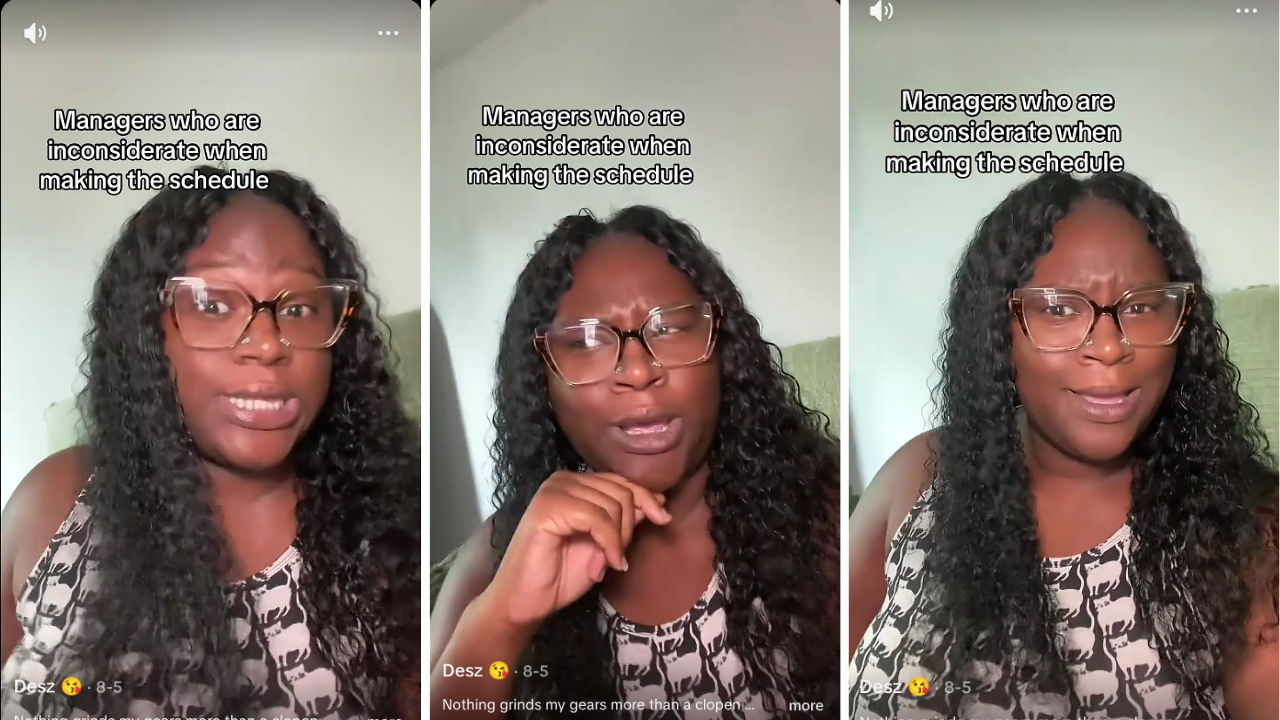
    TikTok creator @deszthebratt has sparked a widespread conversation about scheduling practices in the service industry. Her video, which has amassed over 184,000 views and more than 900 comments, criticizes what she describes as inconsiderate “clopen” shifts assigned by managers in food service and customer-facing roles.

    What Is a “Clopen” Shift?

    The term “clopen” refers to a scheduling practice where an employee is required to close an establishment late at night and return early the following morning to open it. The TikToker recorded her video after a night shift, explaining that this routine leaves her with virtually no personal time between shifts.

    @deszthebratt

    Nothing grinds my gears more than a clopen #retail #customerservice #workbelike #fyp

    original sound – Desz ?

    Creator Details Exhausting Reality of Back-to-Back Shifts

    In the video, she details the grueling timeline: businesses in her mall often close at 10 p.m. and reopen as early as 7 a.m. This leaves workers with only a narrow window to commute, decompress, and sleep before returning.

    She asked, “Why do you think I would want to sit up here, clean the whole store, clean the whole store, set up the store for in the morning, and stay until close?”

    She went on to explain that by the time she arrives home after a closing shift, she has no time for anything else before she must wake up early to open again.

    “Only thing I had time to do was sleep. . . Why do you think I wanna do that?” she said. She added that the managers who assign these shifts have never worked a shift requiring them to close at night and return to open the next morning, calling the practice unfair.

    Commenters Rally Behind Criticism of Scheduling Fairness

    The video resonated with many viewers who agreed that closing-and-opening shifts are universally disliked. Several commenters pointed to a lack of equity in how schedules are constructed.

    One commenter wrote, “And these store managers make the schedule to benefit them and not trying to make the schedule to be fair.”

    Retail Manager Responds: Scheduling Errors Are Often Unintentional

    A self-identified retail manager offered a different perspective, stating that “clopen” shifts are not typically assigned maliciously.

    They wrote, “I’m a retail manager. i make the schedule. I promise when we do that it’s not on purpose. . . making a schedule and trying to place people where they are needed & work around vacations & request days off. . . It’s not fun. lol we make mistakes.”

    The Daily Dot was unable to independently verify the creator’s claims about her work schedule. The details above are based on statements shared by @deszthebratt on TikTok.

  • Woman Shares 3 Rules for Long-Distance Relationship Success: Planning Visits, Communicating, and ‘This Is Expected’

    Woman Shares 3 Rules for Long-Distance Relationship Success: Planning Visits, Communicating, and ‘This Is Expected’

    TikTok creator Chessie, known as @chessie.772, has gone viral after sharing her personal framework for sustaining a long-distance relationship. Her video, which has amassed over 24,000 likes and 187 comments, outlines three practical rules she and her boyfriend follow to maintain their connection while living apart.

    The ‘Three-Month Rule’ and Adjusting to Distance

    Chessie introduces the concept of a “three-month rule,” suggesting that after roughly 90 days, couples begin to confront the day-to-day realities of a long-distance dynamic. Drawing from her own experience, she details three expectations she believes are essential for navigating this phase successfully.

    Rule 1: Always Have the Next Visit Booked

    Uncertainty about the next reunion can amplify the stress of separation. Chessie emphasizes the importance of having a concrete visit planned. She explains that a scheduled meeting provides a tangible milestone to anticipate and offers reassurance that the distance is temporary.

    Rule 2: Prioritize Intentional Communication

    Staying in touch is vital, but Chessie argues that the quality of interaction matters more than quantity. She and her boyfriend have developed a system to make their exchanges more personal. They use an application that delivers messages directly to the recipient’s phone lock screen, ensuring a personalized note is the first thing seen upon waking. This replaces generic “good morning” texts with something more meaningful. Chessie notes that this level of intentional communication is a mutual expectation in their relationship and encourages other couples to discover their own effective rhythms.

    Rule 3: Overcommunicate to Prevent Resentment

    Her final guideline centers on transparency. Chessie advises addressing concerns immediately rather than allowing them to fester. She asserts that proactive discussion resolves potential conflicts before they escalate into larger issues, preserving the health of the partnership.

    The Temporary Nature of Long Distance

    Beyond the specific rules, Chessie reminds viewers that the long-distance phase is not permanent. She urges couples to remain motivated and continue investing effort into the relationship while they navigate the separation.

    Community Response Highlights Shared Struggles and Strategies

    The comment section revealed a spectrum of experiences. Some viewers described relationships spanning years without an in-person meeting, while others discussed navigating four-year separations. Many resonated with Chessie’s emphasis on communication. One commenter encapsulated this sentiment:

    “Being long-distance for 4 and a half years has taught me that it takes a lot of time, patience, and effort, but communication is the biggest key. If something is bothering you or needs to be talked about, bring it up. Don’t let problems sit because they’ll only get bigger. Change is going to happen, and both people have to be willing to grow and make changes when they’re needed.”

    Both Chessie and the commenters who supported her advice converge on a central theme: sustained commitment and proactive effort are the bedrock of a successful long-distance relationship.