Key Highlights
- DreamWorks’ Forgotten Island features a standout voice cast led by Dave Franco as the shapeshifting “weredog” Raww, alongside H.E.R., Liza Soberano, Manny Jacinto, Jenny Slate, Dolly de Leon, and Ronny Chieng.
- The film blends Filipino mythology, Manila cityscapes, and ’80s/’90s American pop culture into a multi-style animated adventure written and directed by Joel Crawford and Januel P. Mercado.
- Forgotten Island opens in theaters on September 25, earning early praise for its emotional depth, animation innovation, and authentic portrayal of female friendship across distance and grief.
Dave Franco’s Raww Anchors a Flawless Ensemble Cast
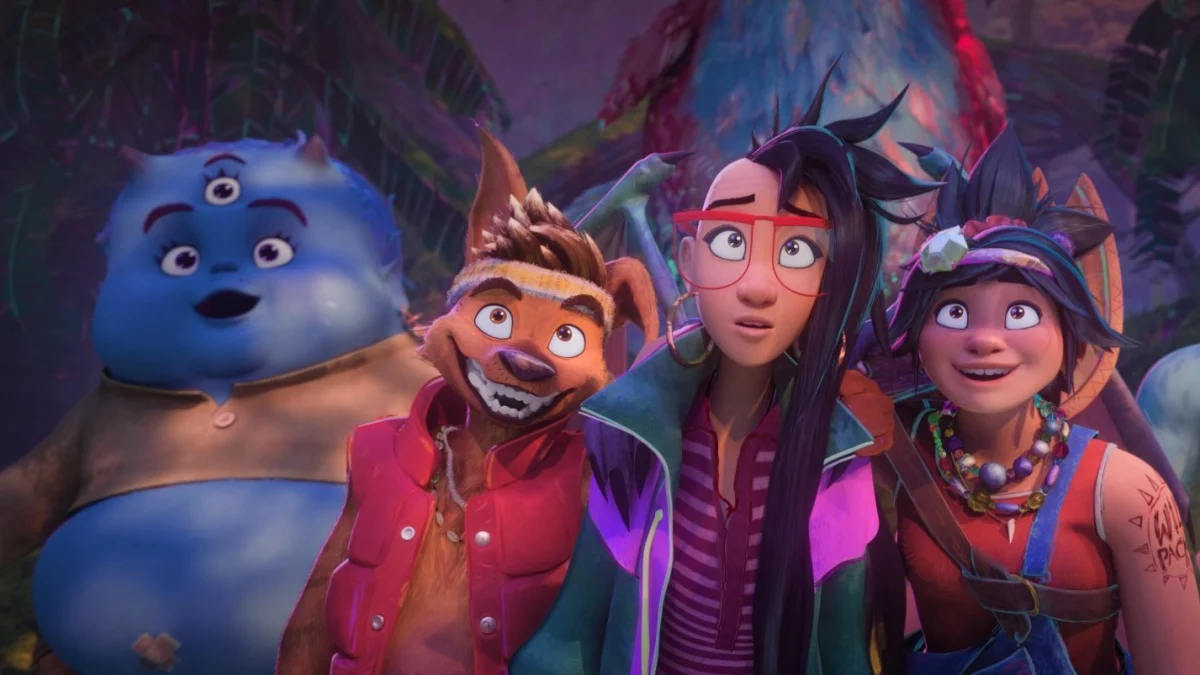
Dave Franco has long specialized in lovable, slightly hapless characters, from Neighbours to Together Together to The Idiots. In Forgotten Island, that energy finds its perfect vessel: Raww, a boy cursed with uncontrollable shapeshifting who transforms into a dog at the mere sight of a stick. Franco’s raspy enthusiasm is, in the words of one early review, “brilliantly distilled” into the role. But he is far from the only standout. R&B star H.E.R. voices Jo, a high-energy chaos curator; Liza Soberano plays Raissa, Jo’s straight-laced, aerodynamics-obsessed best friend; Manny Jacinto portrays a momma-obsessed demon baby; Jenny Slate lends her voice to the memory-collecting Batiba; Dolly de Leon plays a karaoke-loving lola (grandmother); and Ronny Chieng rules the adorable Duwende with comedic fury. Kevin McCann rounds out the principal cast as a comically vain merman. The voice-casting, across the board, has been described as “absolutely flawless.”
A Friendship Forged in Manila, Tested in Nakali
Written and directed by Joel Crawford and Januel P. Mercado, Forgotten Island opens in the Philippines, where Jo Yuson makes a memorable impression at her new school with an elaborate family-history project on Nakali—a fantasy island populated by demons, including the dreaded Manananggal, a vampire that splits in two to hunt. While classmates mock the presentation, bespectacled Raissa defends Jo’s aerodynamics of the Manananggal, landing them both in the principal’s office and sparking a lifelong friendship. That bond is chronicled through a charm bracelet marking slumber parties, Predator marathons, karaoke sessions, and the messy glory of growing up weird together.
The story accelerates on their last night before Raissa departs for college in California. Jo, adrift and barely employed, joins Raissa for a final evening that ends with both tumbling unexpectedly into the real Nakali. They awaken with new accessories, unexplained haircuts, tattoos, and no memory of their first night on the island. With the chaotic Raww as guide, they retrace their steps to recover their memories and find a way home before Raissa’s flight.
Animation That Breaks the Disney Mold
Crawford and Mercado embrace a visual language as restless as their heroines. The film’s opening sequences showcase the natural beauty and urban bustle of the Philippines before launching into Nakali, where mythical creatures burst with neon-drenched color and character. The directors cite Spider-Man: Into the Spider-Verse and KPop Demon Hunters as stylistic touchstones, shifting fluidly between 3D, 2D, anime, manga, and chibi aesthetics. When Raww recounts meeting the girls, his flashback “goes full Goku.” As Jo and Raissa hear their forgotten story told by others, the animation morphs to reflect each narrator’s perspective. This stylistic flexibility keeps the adventure unpredictable while allowing the characters to “scream, cackle, and ugly cry”—expressions that deliberately break the polished Disney princess mold.
The soundtrack leans into the film’s American pop inspiration, deploying Journey’s “Don’t Stop Believin’” and Montell Jordan’s “This Is How We Do It” alongside the kinetic, spirited animation that mirrors the heroines’ liveliness.
Grief, Growth, and the Sheep Detectives Comparison
Early viewers have drawn a parallel to 2026’s The Sheep Detectives (now streaming on Prime Video), a film that disguised profound grief beneath a silly premise. Forgotten Island executes a similar feat. The emotional core crystallizes in a second-act montage nurtured by Jo’s lola, a “moxie-rich old broad” who inspires the girls to love each other “loudly and unapologetically, just as the weirdos they are.” Her eventual death lands with force, leaving audiences on the brink of tears before the film pivots back to island chaos, Odd Couple banter, and radiant joy. The screenplay then reconnects with the separation anxiety that preceded the fantasy plunge, asking: how do you preserve a friendship when life pulls you apart?
While the third act reportedly hurries to tie up the island-misfit threads alongside the central relationship, the tender drama at the movie’s core “hits hard.” H.E.R. and Soberano etch an “easy intimacy” into Jo and Raissa that feels both real and “frighteningly fragile.” At a recent press screening, one vocal child let out a “high chirp of distress” during the emotional climax—yet the film delivers a “sensational and satisfying” ending reassuring viewers that “being a weirdo works out once you’ve found your wild pack.”
Why This Matters
Forgotten Island arrives at a pivotal moment for mainstream animation. By centering Filipino culture—not as backdrop but as narrative engine—DreamWorks continues the industry’s slow shift toward culturally specific storytelling that resonates universally. The film’s integration of Tagalog terms (lola, Manananggal, Duwende), Manila cityscapes, and intergenerational family dynamics offers representation rarely seen in wide-release American animation. Simultaneously, its multi-style visual approach signals growing creative confidence in post-Spider-Verse animation, proving audiences embrace stylistic heterogeneity when it serves character and emotion. The September 25 theatrical release positions the film as a late-summer family tentpole with potential awards-season legs, particularly in animated feature and voice-performance categories. For DreamWorks, it represents a continuation of the studio’s post-The Bad Guys creative renaissance under Crawford’s leadership.
Frequently Asked Questions
When does Forgotten Island open in theaters?
Forgotten Island opens in theaters on September 25.
Who are the writers and directors of Forgotten Island?
The film is written and directed by Joel Crawford and Januel P. Mercado.
What cultural elements does the film incorporate?
The film celebrates Filipino culture through its Manila setting, Tagalog terminology (lola, Manananggal, Duwende), mythology, karaoke traditions, and the central friendship between two Filipino girls, while also weaving in ’80s and ’90s American radio hits like Journey’s “Don’t Stop Believin’” and Montell Jordan’s “This Is How We Do It.”
Leave a Reply